I am querying–for those who do not know what that term means, (and don’t fear–I didn’t either until about two years ago.) I am looking for a literary agent to represent me and my writing–specifically The Weight of Mercy. I dream of publishing with one of the big Christian houses and therefore need a champion to sell my book. Obtaining a literary agent is daunting. They receive 1000’s of queries and typically only choose to represent a handful of clients a year. The chances are slim–but I gotta shoot my shot.
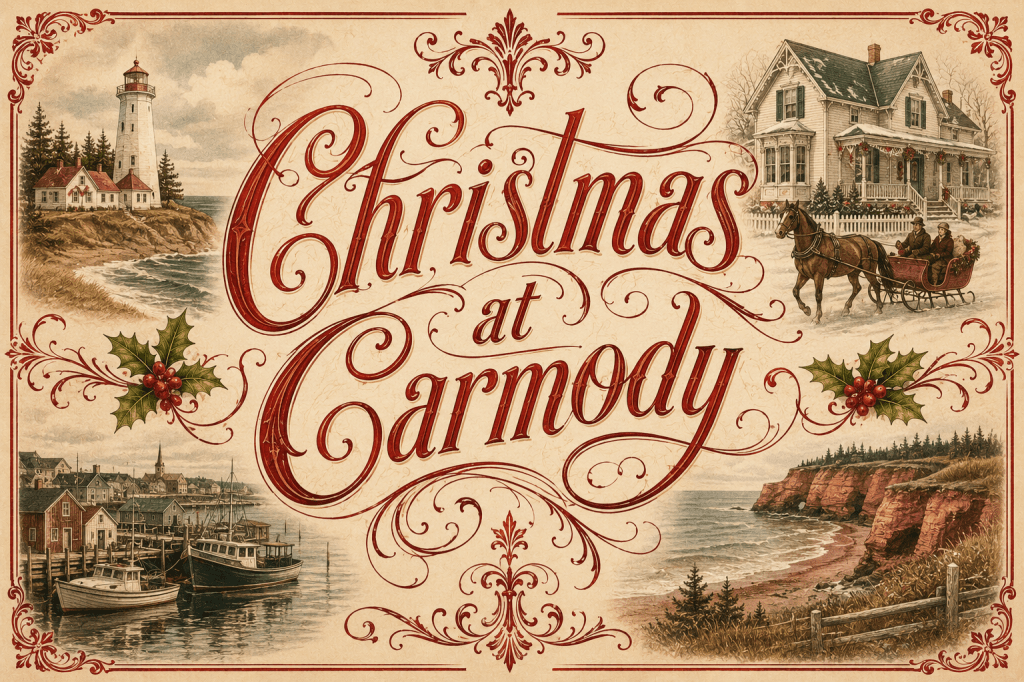
In the past month I’ve sent out 19 queries and received one rejection. The process can take a long time. To fill my time constructively, instead of checking my email 20,000 times a day, I have decided to write a Christmas Novella set in the town of Carmody on Prince Edward Island. As a child my sister and I spent hours watching Road to Avonlea. The early 1900’s are one of my favorite time periods. The dawn of invention, the Edwardian clothes, the simpler world. It all speaks to me. Prince Edward Island is filled with quaint fishing villages and beautiful vistas. It’s a world that even though I’ve never visited I feel close to.
Below is Chapter One of this venture. Once completed it will be a free e-book to any of my newsletter subscribers. My gift to you–the reader. Until then-Can you give me your feedback? I’d be ever so grateful. Does it speak to you as well? Ignite your imagination?
I’d love to get your feedback – constructive or otherwise. Please respond to this email and enjoy Chapter One of Christmas at Carmody!
Chapter One
I pressed the ends of the brown paper wrapping strip together. There. My first chain was complete.
Annabell Kramer leaned across the desk, her top lip curled. “Look at that ugly paper, Lusie McPhee brought from home. Are you sure you didn’t steal that from the general store?”
I hung my head low. Mama had saved every bit of extra paper she could ever since I’d told her Miss Honeylee had secured a real Christmas tree for our classroom and requested we bring what decorations we could spare from home.
“Yeah, looks worse than anything coming from a poorhouse. I guess that’s what we can expect from a girl that lives in a lighthouse.” Bessie Tooney chimed in as she stuck her tongue out at me.
“Children. That is not the Christmas spirit,” Miss Honeylee chided. “Lusie’s father provides an important service to our community as the lightkeeper.” She pulled a silver pocket watch out of her vest pocket, popped open the hatch, looked at the time, then clicked it shut.
My teacher lived up to her name. Her honey-colored hair swept back into a chignon. I’d always wished for blonde hair, but God didn’t deem it fit for me. Instead, he gave me hair as brown as a sallow mud hen.
Miss Honeylee came and stood beside my desk. “It looks lovely, Lusie. Thank you for your contribution.” Her hand settled on my shoulder, warm and heavy. I soaked up the attention–please that Annabell and Bessie were put in their place.
“Come, children.” Miss Honeylee lifted her skirts, her shoes clicking up the aisle to her desk. “Let’s dress the tree for our party.”
“Don’t pay them mind,” whispered Tinny beside me. “They are full of hot air.”
“Easy for you to say,” I replied. “At least your paper didn’t come from the kindling pile.”
Tinny didn’t speak. Instead, she squeezed her eyes shut, gathered a breath, and took my hand and led me to the front, her head held high. I knew her ways–her exasperation with hesitancy. Tinny was like that. She had no shame, even proud of her outlandish name, Petunia MacDonald, which she’d shortened to Tinny.
The wood stove sat in the center of the schoolroom, warmth radiating from its belly. Outside, drifts of snow, sparkly in the sunlight, piled against the one-room Carmody schoolhouse. One would think its rays would offer some sort of warmth, but the extra wood in the stove told otherwise. I shivered thinking of the impending walk home in my thin leather boots; at least Mama’s wool socks would keep me warm.
“Miss Honeylee, are you going to announce the town hall meeting tonight?” Annabell asked in her nasal, high-pitched voice as she wound her shiny red paper chain around the bottom boughs of the tree. “My mother is the president of the Ladies Society of Carmody, and they have a special Boxing Day project they will be presenting.”
Annabell gave me a pointed look at the words Boxing Day. My stomach flipped.
“We can never keep the poor too far from mind during the Christmas season,” Annabell continued in her high, nasally pitch.
Miss Honeylee sat behind her desk. “Yes children. Please remind your parents about the meeting tonight. 7 o’clock at Town Hall. There is to be a special vote about the extra railroad line coming into town. Everyone is welcome.”
“I wonder what the Ladies Society is going to present,” said Tinny in a low voice.
“Will you come?” I whispered back.
“I think Papa’s planning to. I’ll ask him to come. See if you can come, too, and we’ll sit together.”
My Papa rarely went to town hall meetings. Said those hoity toity town folk could hold airs to themselves. Besides, someone had to man the lighthouse while we were away, but maybe an assistant would be on for the night. It would be hard to convince him, but I was up for a challenge. Plus, spending an evening with my best friend sounded nice. I’d find a way to attend that meeting one way or another. I may not have Tinny’s confidence, but I was smart and conniving; besides, we were townsfolk just as much as snooty Annabell and her family.

Papa came home from the docks at six o’clock smelling of fish and oil. After taking his galoshes off from over his boots, he slouched in a kitchen chair and propped his feet up. “Lusie girl. Will ye take off my boots for me? I’m plumb tuckered out.”
I knelt in front of Papa’s feet and undid the laces on his leather boots. The thick rubber soles contrasted with the leather, which had worn thin around the toes. I tugged, but the boots stayed on snug.
“Pull harder, Lusie.”
I pulled as hard as my ten-year-old self would allow, and the boot came off with a thud, sending my backside to the dirt floor. “Oof!”
Papa chuckled. “Time we get some muscles on you.”
“Papa? Did you know there is a town meeting tonight?”
“Yah. Willie Lester mentioned it at the docks. We ain’t going.”
“Why Papa? Do you need to man the lighthouse? We are good citizens of this town. Seems we should have some say.”
“No. Murdo is on duty tonight. Did you hear something at school about the vote?”
Saliva pooled in my mouth. I needed to see what the Ladies’ Society had planned. It had something to do with us. I just knew it by the way Annabell made sure I heard the announcement. “Miss Honeylee invited everyone to come. Annabell Kramer said her Mama had a big announcement about Boxing Day. Papa, we could use the charity.”
Papa’s shoulders slumped, and his face dropped. I’d never noticed how weary his face had become. His whiskers sprouted gray, and deep lines furrowed on his forehead, weathered by the countless hours squinting out to sea from the lighthouse. When not on duty, he fished and worked the docks to provide for us.
He growled, “We have no use for charity. I’ve got work and we’ve got this home–besides that’s not the primary matter on the agenda. They are voting on expanding the railroad. Whatever I have to say about it won’t matter anyway–those rich folk always win.”
Mama cut a look at him. “Forget the railroad. She’s right Walt. We could use the charity. An extra box of provisions would go a long way in the winter.”
Our lighthouse home was snug but small. Mama made sure to keep it clean, opening the windows and doors every day of the year, no matter the weather, to keep it aired out. Braided rugs kept our feet clean and warm on the swept dirt floor in the main section. Mama and Papa’s bed occupied a corner on the right-hand side, while the stove and kitchen took up the other part. My bedroom was on the second floor of the lighthouse itself, up a winding spiral staircase. The two windows in the circular room overlooked the red cliffs of the southern shore. At night, I fell asleep to the waves crashing against the rocks.
My seven-year-old brother, Jude, burst through the door, his cheeks rosy as an apple in September. “What’s for supper, Mama? I’m hungry enough to eat a whole horse, shoes and all.”
“Fish stew,” Mama replied.
Jude wrinkled his nose. “Again? We’ve had it for five straight days.”
“You’ll do well not to look a gift horse in the mouth. We at least go to bed with full bellies. The young’uns over at the O’Toole’s have been getting stick thin. They say all they’ve been eating is watered-down porridge.” Mama retorted.
Papa got a twinkle in his eye. Reaching beside him, he picked up his fiddle and sang a ditty. “Fish stew in the morning. Fish stew at night. Fish stew’s mighty good when you need a bite.”
I giggled. “Play it again?” I loved when Papa played his fiddle.
Papa’s fiddle started slow. He pulled the bow over the strings, and they released a mournful note. “Fiiiiissshhhh steeeeewww in theeeee morrrrnninnggg.” The next time he played it faster until the bow flashed back and forth in the sparkling snow coming through the window. Jude hiked up his pants and danced. Stick knees poking up in the air, he took off his cap, his hair wild and blond stuck up off his forehead. I joined him, singing the fish stew song as fast as we could until we collapsed in a heap on the cold dirt floor.
Papa put down the fiddle. “Now, do you mind taking off this other boot?”
“Can we go tonight, please, Papa? Please?”
Papa sighed. “I sure have a hard time sayin’ no to you, and I suppose you’ll keep asking till I agree. You eat your Mama’s delicious fish stew without complaint, and we’ll go.”
I caught the corner of Mama’s lip lift a bit.
Papa put his cap back on. “You best put the other boot back on, Lusie, if we gonna go out tonight.”
I couldn’t help but hide the grin that took over my face. We were going to that meeting.

“Lusie! Come over here.” Tinny patted an empty seat next to her. Oil lamps illuminated the wood floors of the meeting hall. Benches sat in tidy lines all the way to the front of the room where a raised stage had a table laid out for the council. Papa took off his hat, and he and Mama sat in the back. Tinny and I positioned ourselves in the row in front of them. The stomping of boots and shoes filled the vestibule as townsfolk shuffled in. Annabell and her parents trotted up to the front row. Her nose pointed down at me as she passed.
Miss Honeylee paused at our bench. “Pardon me, girls. Can I squeeze in next to you?”
I slid down closer to Tinny, concerned Miss Honeylee would smell the fish stew on my breath.
Up front, Constable Henry, seated in the middle of the town council, hit the table with a gavel. “I’d like to call this meeting to order. First on the agenda: the felling of trees just outside the town limits. As you know, the railroad company wants to add another line coming into Carmody to double the passengers coming to and from Charlottetown. They are askin’ to clear out those woods on the Taylor farm. The Taylors have agreed, but we need to put the extra line to a vote for the town to sign off on it. All those in favor say ay.”
Hands raised all over the Townhall. Papa didn’t raise his. I wondered why.
“Looks like we are all in agreement. We’ll add an extra rail line to the Charlottetown-Carmody route. Next up, Mrs. Roland Kramer has asked for the floor to give an update on the Ladies Society Boxing Day event. Mrs. Kramer,” Constable Henry motioned for Annabell’s mother to come up front.
Mrs. Kramer stood. She wore a fancy hat with ribbons and feathers swooping every which way. Her dainty boots clicked on the floor, and her wool skirt dyed crimson red swooshed with every step.
I held my breath. What did Annabell have up her sleeve?
Mrs. Kramer swept her hands to the left and to the right. “Ladies and gentlemen. Every year the Ladies Society puts together boxes for the poor among us to give out on Boxing Day. This year I have reached out to the Charlottetown Ladies Society to combine forces for a special Boxing Day charitable exchange. The goal is for every child in Charlottetown and Carmody to experience a proper Christmas. Families from both towns have stepped up to host a child on Boxing Day. The poor children in our towns will receive a Christmas feast, a present, and a box of goods to take home. Sign-ups will begin this evening and last through the 23rd.”
Tinny elbowed me, her eyes wide. “You think your folks will sign you up?”
“No. Papa will never agree to taking charity. He thinks those women are a bunch of biddies with poor intentions.”
A hand flew to Tinny’s mouth to hide her chuckle.
Mrs. Kramer narrowed her eyes at Tinny.
“You’ve upset the ole’ biddy.” I whispered in Tinny’s ear.
Tinny couldn’t help herself. She snorted.
Papa pinched the back of my arm, and I straightened.
“Thank you, Mrs. Kramer.” Constable Henry tipped his hat. “We’ve concluded our business for this evening. Refreshments will be served, compliments of the Ladies’ Society.”
My mouth watered when the ladies’ society lined up individual plates dotted with cream puffs on the table set out to the side. Papa pulled my arm. “Come, let’s take our leave.”
“Can I have one, Papa?” I lifted my dark eyes to his stubble. “Please?”
Mama stepped beside Papa. “Walt. Let the children indulge for once. It’s near Christmas after all.”
Papa buttoned the one lone button on his coat. “Go on. We’ll be waiting for you out front. Take it and eat it on the way home.”
Tinny and I joined the refreshment line.
“I hope my folks sign me up for Boxing Day!” Tinny whispered into my ear.
“Me too.” My heart yearned for a meal besides fish and a real Christmas present, but there would be no way Papa would let us. The McPhee pride ran deep. I stuffed my Christmas wish back into its stocking and vowed not to ask.


 Sarah Heatwole
Leave a comment